Saturday, January 5, 2019

The Leotax Leica Copies

    I don't know how many Leotax cameras Showa Optical Works/Leotax Camera Company produced, but I have several of them in my collection. Because they are copies of the Barnack Leicas, the Leotax F, K, and  K3 (photo right) are similar in appearance. But a closer look reveals that they don't necessarily share the same mechanical features.
    For example the F (red dot) and the K3 (yellow) have slow speed shutter dials, which the K (blue) lacks.
   The F has a top shutter speed of 1/1000 as opposed to a top speed of 1/500 on its twins.
   The F and K feature FX levers, but the K3 lacks one.
   The K3 reveals 50mm frame lines in its viewfinder, but the F and K do not.
   The F and the K are labeled Showa Optical Works, Ltd. This indicates that they appeared earlier than the K3, which is labeled Leotax Camera Company, Ltd.
   Other than those differences (and a few minor ones), all three cameras have the same viewfinder/rangefinder windows, PC connections, as well as the same arrangement of controls on their top plates. All of them are bottom loaders. More about that later.

    Not shown above, the Leotax TV (Leotax Camera Company) is probably a later model in this series of Leica copies. Manufactured in 1957, it shares many of the characteristics of its older cousins while adding a self timer (blue dot). The green dot reveals the slow shutter speed dial, (T, 1, 2, 4, 30, 15, 8). As is true with the  the K and K3, the highest shutter speed on this model is 1/500.The red dot marks the focusing knob of the Industar-26 2.8/50mm lens mounted on the unit.
   The viewfinder/rangefinder window is the same as those found on the units pictured above.
     The Leotax Camera Company produced just  3,000-4,000 Leotax TVs in 1957. 

     Except for its film advance knob, the controls on the top plate of the Leotax TV are identical to those on the F, K, and K3.
         From left to right, rewind knob (yellow); viewfinder/rangefinder windows (white); accessory shoe (dark blue); PC connector (gray); shutter speed dial (light blue); shutter release (green); advance/rewind lever (violet); film advance knob (mustard).
      The film advance knob on the model TV differs from that of the models K and F as shown in the photo (left). The models K and F feature a red, white, and black film type/ASA indicator, while the model TV (and the K3) have small windows that house an ASA indicator.
                                                      
      Like the  Leotax F, K, and K3; the Barnack Leicas; and some Russian copies, the Leotax  K3 loads through the bottom. Many photographers have found loading film through the bottom so frustrating that they've thought about jumping from bridges or slitting their throats.
   Others have used tank loads of ink to propose solutions to the problem.
       Still others have spent their children's milk money to buy special film cutting devices.
      But such extreme measures aren't necessary. Shown here courtesy of jay.fedka.com/index_files/Page345.htm is a suggestion for a template  that offers an inexpensive, easy, do-it-yourself solution to the problem. Follow the link for more specific information.

COMING SOON: Agfa Karat 36


Wednesday, January 2, 2019

The Canon 7SZ and the Canon 7


      I was lucky when I bought this Canon 7SZ together with a Canon 3.5/135mm LTM lens at an Internet auction site for just $171. I say lucky because collectiblend values the body alone  at $340-$900. But that's not all.  Because Canon produced just 4,000 of them, the 7SZ is considered
scarce and highly collectible. And, to make the deal even better, this unit is in excellent condition.
    Manufactured from 1967-1968, the Canon 7SZ is similar to its near twin, the Canon 7S (not shown). Both cameras feature metal shutters; both are labeled 7S (there's no logic to this); both require batteries to operate their exposure meters; and both have outer bayonet mounts for the legendary Canon .95/50mm lens. The 7SZ, however, has a larger rewind knob. Because I'm not technically oriented, I don't know if other differences exist between the two cameras.
       As you would expect, these two cameras require outlawed mercury batteries to activate their meters. Believe it or not, my 7SZ came with one that still had life in it. If I were planning to use the camera, I suppose I'd have to find an alternative to the mercury battery soon. But I think my Canon 7SZ #121750 will spend eternity in my display cabinet.

     Between 1961 and 1965, just a few years before they produced the 7S and the 7SZ,  Canon introduced the Canon 7 (photo right). Seen from the front, the 7 bears a close resemblance to its cousins. The cameras share the same body, viewfinder window, self timer, and LTM/Bayonet mount. Like the 7SZ, the Canon 7 features a metal shutter.
     The two cameras differ, however, in the 7's   rectangular light gathering window that serves its selenium light meter as opposed to 7SZ's circular eye.
    Although most of these more-than-fifty-year-old cameras have wrinkled shutters, the one shown here does not. I suppose that would make it more desirable than many others. By the way, if they're not too badly damaged, wrinkled shutters don't affect the operation of these cameras.

      Seen from the top, the differences between the two cameras are obvious. Because the Canon 7 (red dot) features a selenium exposure meter, its meter window differs from that of the 7SZ. The 7 also has a rewind knob and lever that's smaller than that of the 7SZ, as well as a protuberance in front of the shutter release button to contain the camera's plastic bubble window for its exposure meter. The 7SZ, by contrast, mounts an accessory shoe, which is lacking on the 7.
     That said, the field of view adjusting dials next to the rewind knobs on both units provide for the same 35, 50, 85, 100, and 135mm views and are identical in appearance. The film speed dials, shutter release buttons, film counters, and film advance levers are twins as well. Both cameras have those little telltale circular windows with red dots that revolve when you advance the film...a nice touch.

     Viewed from the back, you can see a small dial to the right of the Canon 7's (red dot) eyepiece . That's the high range-low range switch. Just above the switch there are two tiny screws. If you know the purpose of those screws, please let me know.
     On the 7SZ you can see a somewhat larger dial below the black shutter speed dial. That's the battery check/on/ off switch.
     Other than those differences, the backs of the two cameras are identical.
      Are you wondering what those two little buttons to the left of the names and serial numbers of both cameras are for? Well, they're spring loaded gizmos that you depress to change the ASA settings on the camera's shutter speed dials.

     If I had my druthers, which of these two excellent cameras would I prefer? For me that's a no brainer. Because I don't like to rely on a battery operated meter; because I have no need for an accessory shoe; and because I've never used a flash unit for my mostly outdoors photography, my choice would be the Canon 7.

     In the past I used this  more than fifty-year-old camera  for street photography in New York City. The lens I used was a Russian 2.8/53mm Industar-61 lens (see "What about Those Russian Lenses?").  Here are two samples of the images it produced. As I recall, these were quick grab shots at f11 1/250 with the camera pre focused at 10 feet. I think I was using Kentmere film for both photos.

COMING SOON: The Canon VT


Friday, December 28, 2018

The Canon P and the Canon L2


     This blog entry should really be titled "Confessions of a Former Leicaphile." Although I used Leicas (M-2, M-3, M-4, M-6) almost exclusively for more than forty years, I was pleasantly surprised when I discovered the  wonderful Canon copies of the fifties and early sixties a few years ago. That's when I sold my treasured Leica gear and started shooting with a Canon L2, shown at the right here wearing a Russian Industar-61 2.8/55 lens (see "What about Those Russian Lenses?" 11/14/2018.)
      I liked the Canons so much that I added the following models to my collection:  IIB, IID,  IID2, IIF, IIS2, IIIA, IVSB2, VT, 7, 7S, P, and  L2. Hopefully, I'll be able to add even more in the future.
 
     Manufactured between 1949 and 1956, the II, III, and IV models resemble the Barnack Leicas (below, left). Later models (1956-1967) are similar to the L2  at least in terms of their appearance.
     But there are differences. In the photo (right) you can see that Model P (red dot) has a self timer, while the L2 (blue dot) lacks one. You can see, also, that the L2 has a slow speed dial.
     Not shown are the two shutters. The shutter on the L2 is fabric, while the P features a metal shutter. I was lucky enough to find one that was wrinkle-free...a rarity.
    With lines marked for 35, 50, and 100mm fields of view etched into it, the viewfinder on the P is slightly larger than the one on the L2. The L2 has a dial on its back that lets you adjust it to view 35, 50, and RF (100mm?) fields of view. I prefer the view shown on the Canon P.

     Viewed from above, the two cameras are identical in shape. But notice the difference between the two rewind knobs. The L2 (blue dot) features a spring loaded pop up rewind knob.  The Model P, by contrast, has a traditional rewind lever that folds up. Except for the ASA indicator on the L2, the film advance levers and film counters are the same on both cameras.
      Because it lacks the 35, 50, RF indicator found on the top of the L2, the Model P (red) appears have a somewhat  cleaner look to it.
      Note, also, the differences between the two dials that set the shutter speeds, as well as the higher shutter speed of 1/1000 on the Model P.

     Viewed from the rear, the Canon L2 (blue dot) reveals a black square that's slotted at it's top, probably to receive a card with photo/film information on it.The L2 also has a round viewfinder window as opposed to the rectangular window on the Model P. The small dial used to adjust the field of view on the L2 is  just below and to the right of the viewfinder window.
     The Model P sports an ASA-ISO indicator that can also be set to "Empty" when there's no film in the camera. The backs of both cameras swing open for easy loading. That's quite an improvement over the back loading Canon IIs, IIIs, and IVs, as well as the Barnack Leicas.
      At this writing, collectiblend values the Canon L2 (body only) at $100-$260 and the Canon P (body only) at $90-$260.
      Which of the two cameras do I prefer? Drum roll, please. If you said, "The Canon P," you'd be right. Here's why: (1) the parallax corrected viewfinder on the "P"contains frame lines...no cumbersome dialing needed, (2) there's a single speed shutter dial on the "P," and (3) the "P" has a metal shutter. Plus, I just like it better.


COMING SOON: Canon 7 and Canon 7S


Wednesday, December 26, 2018

The Aires 35 IIIC

      Several of the vintage rangefinders in my collection suffered from dim rangefinder patches, and the Aires 35IIIC was no exception. Fortunately, I discovered an easy fix for this condition on the Internet at http://rick_oleson.tripod.com/index-165.html.  It's  simple. You just place a small black
circle in the center of your camera's viewfinder window, and you're back in business. In the photo, right, I substituted a white dot for the apparently dark window.
    By the way, the viewfinder features automatic parallax correction.
      This camera has a few unique features that I haven't seen on other 1950s RF cameras. For example, the little lever (my red dot) allows for intentional double exposures and also allows for rewinding the film.
     Another interesting feature is the f2.4 lens. I don't think I've ever seen an f2.4 lens on another 35mm camera, but I suppose the designers at Aires Camera in Tokyo had a reason for including one on this camera. The self timer lever is at 9 o'clock in relation to the lens.

      The controls on this camera are straightforward and easy to adjust. The yellow dot denotes the combined aperture opening and LV system ring. Blue marks the shutter speed adjusting ring. Green highlights the XFM synchro switch ring. Red marks the focusing ring, and black denotes the depth of field scale. Note that distances are shown in meters.
     An old timey flash socket peeks out at 3 o'clock on the black shutter speed indicator ring. The focusing knob doesn't show up in the photo.
     This camera sports a Seikosha MXL leaf shutter that is extremely quiet...perfect for street shooters.

    Seen from above, the Aires 35IIIC looks like most other rangefinders of its time, except for the shutter release, which sits in a small depression with a cable release socket directly to its rear. I found this arrangement to be quite comfortable. That's interesting because most other shutter releases are elevated above their cameras' top plates.
    Note, also, the curved area in the top plate into which the film advance lever usually fits snugly. But when you advance the film and cock the shutter, the lever sets itself slightly apart from its usual resting place, where it is ready to operate once again. The hinged back swings open for easy film loading.

    Another nice feature is the camera's metal lens cap. The red dot in the photo marks a small eye that can accommodate a lens leash, which can consist of just a length of black thread. I have to smile each time I think about the many lens caps I've lost because I hadn't tethered them to my cameras.
    Not too long ago, I paid $60 for this camera in excellent condition except for the dim RF patch. The Collectiblend website currently values it at $80-$220. My 1995-1996 McKeown's lists it at $45-$60.

COMING SOON: Canon L2 and Canon P


Friday, December 21, 2018

The Retro Ricoh "35"


   If you're old enough to have driven cars that had no power brakes, no power steering, and no air conditioning, you'll probably relate to the Ricoh "35," truly a minimalist's dream if ever there were one. With its fixed 3.5/45mm lens and shutter speeds that top out at only 1/200, it certainly won't leave anyone gasping with anticipation. But as Tevya often said in the film Fiddler on the Roof, "On the other hand..." it does have much to recommend it to the thinking photographer who enjoys the process of creating images as much as he enjoys the results of his efforts.
      Manufactured in the mid fifties, this camera is at least as well-crafted as any other camera of its time. Interestingly, it features not only a knurled knob to advance the film and cock the shutter, but also a trigger wind to perform the same functions. The integrated viewfinder/rangefinder window is bright, and the rangefinder patch is well defined. The leaf type shutter is satisfyingly quiet. The back slides off for easy film loading.  But if you were to ask me about those two humps at 12 o'clock and 9 o'clock in the photo (above), I'd have to admit that I have no idea what they're for.

     In the photo (right) you can see the trigger wind lever at the bottom of the camera (yellow dot), the focusing knob (red), the old timey flash connector (purple) and the two large knobs that hold the removable back in place. The white dot at the left rests on the tripod socket.
     As I recall, I paid about $60 for this camera not too long ago. Curious about its current value, I checked with collectiblend.com where it's listed at $240-$520 depending on its condition. Then I consulted my 1995-1996 copy of McKeown's price guide where it's listed at $30-$45. Well, I thought, maybe I should have bought a dozen or so Ricoh "35"s when I bought this one.

    Seen from the side (photo right), the shutter speed indicator ring is shown by the blue dot. The thin knurled ring (red) next to it is the shutter speed adjusting ring. The purple dot denotes the f stop values, while the green dot marks the click stopped diaphragm adjusting ring. The yellow dot shows the focusing ring with its adjusting knob. Not shown in the photo is the depth of field scale, which appears on the front of the camera.

   Viewed from the top (photo left), you can see the film advance knob, film counter, and shutter release at the traditional right-hand side of the unit. The small button near the film advance knob disables the advance mechanism when it's time to rewind the film.  In the photo you can also see the integrated viewfinder/rangefinder window, which wasn't always present in many other cameras during the fifties.

    Some photographers claim that an f3.5 lens, a top shutter speed of 1/200, and no provision for electronic flash are a handicap. I suppose that's true in many cases. But during the more than sixty years I'd been active in photography, it wasn't true for me. In fact, I probably used an f stop wider than 5.6 and a shutter speed slower than 1/30 or faster than 1/500 no more than two dozen times during all those years. What's more, I rarely used a flash unit.
    Although I must admit that I'm not crazy about its trigger wind,  I really like everything else about the Ricoh "35." And I'd like it even better if it had strap lugs. I never could figure out why some designers omitted them from their cameras.

COMING SOON: The Ricoh S-2


Tuesday, December 18, 2018

The Regal Mamiya Crown

    If you think the little white dot in the center of this Mamiya Crown's viewfinder window is a specular reflection, you'd be mistaken. Here's why. Although it was in excellent condition when I obtained it, this fairly rare camera had one problem: the rangefinder patch was dim. Luckily, I remembered having read about a quick and easy solution at http://rick_oleson.tripod.com/index-165.html.  All you have to do is to place a small black dot in the center of the viewfinder window. But because the window in the photo appeared as black, I substituted a white dot for illustrative purposes. 

       Seen from above, the camera resembles most other 35mm cameras of the fifties. The film advance lever, film counter, and shutter release are at the right. The accessory shoe is at the center of the top. The rewind knob is at the left. Interestingly, the ASA indicator is found between the rewind knob and the accessory shoe. A film type indicator sits between the shoe and the advance lever. The camera features a hinged back.

     The f1.9 48mm Mamaiya Secor FC lens (photo, top right) is ideal for low light situations.   Shutter and diaphragm controls are conveniently located. The red dot (right) marks the click stopped diaphragm control ring. Blue denotes the EV system ring. Yellow shows the shutter speed control ring. Green indicates the depth of field scale. Violet marks the distance scale, and black shows the focusing knob. By the way, when I received the camera, the focusing ring was stiff and difficult to turn. Fortunately, a few drops of lighter fluid (naptha) solved the problem. An old timey PC connection peeks out just to the right of the green dot.

     If I hadn't been able to loosen the focusing ring and correct the rangefinder patch on this camera, it would have been extremely difficult to use. But as the Bard wrote, "All's well that ends well." Even though it lacks the refinements found in some other rangefinder cameras, the Mamiya Crown is a nicely designed, well made, and reliable unit that can still produce excellent photographs.
COMING SOON: Ricoh 35


Saturday, December 15, 2018

The Minolta Super A


    Compared to other rangefinder cameras of the fifties, the Minolta Super A (left) seems massive. In fact, it's like viewing a rowboat placed next to a tugboat. For example, the top plate of a Canon IID2 (right) measures about one-and-one-eighth of an inch from front to back.. The Super A, on the other hand, is one-half of an inch wider across its top. And it's almost one-half an inch taller as well. Notice how squat the Minolta appears to be as contrasted to the Canon.


    "What's that round dial peeking out of the top of the camera?" you ask. Believe it or not, it's the shutter speed adjustment dial (B, 1, 2, 5, 10, 25, 50, 100, 200).
     And that small slot below the rangefinder window? Well, when the shutter is cocked, the slot changes from silver to red. I really can't see how that's of any great value.
     The flash synch selector dial surrounds the PC socket near the base of the camera. The focusing knob is shown at the three o'clock position in the photo. The camera doesn't have a self timer or a hot shoe.

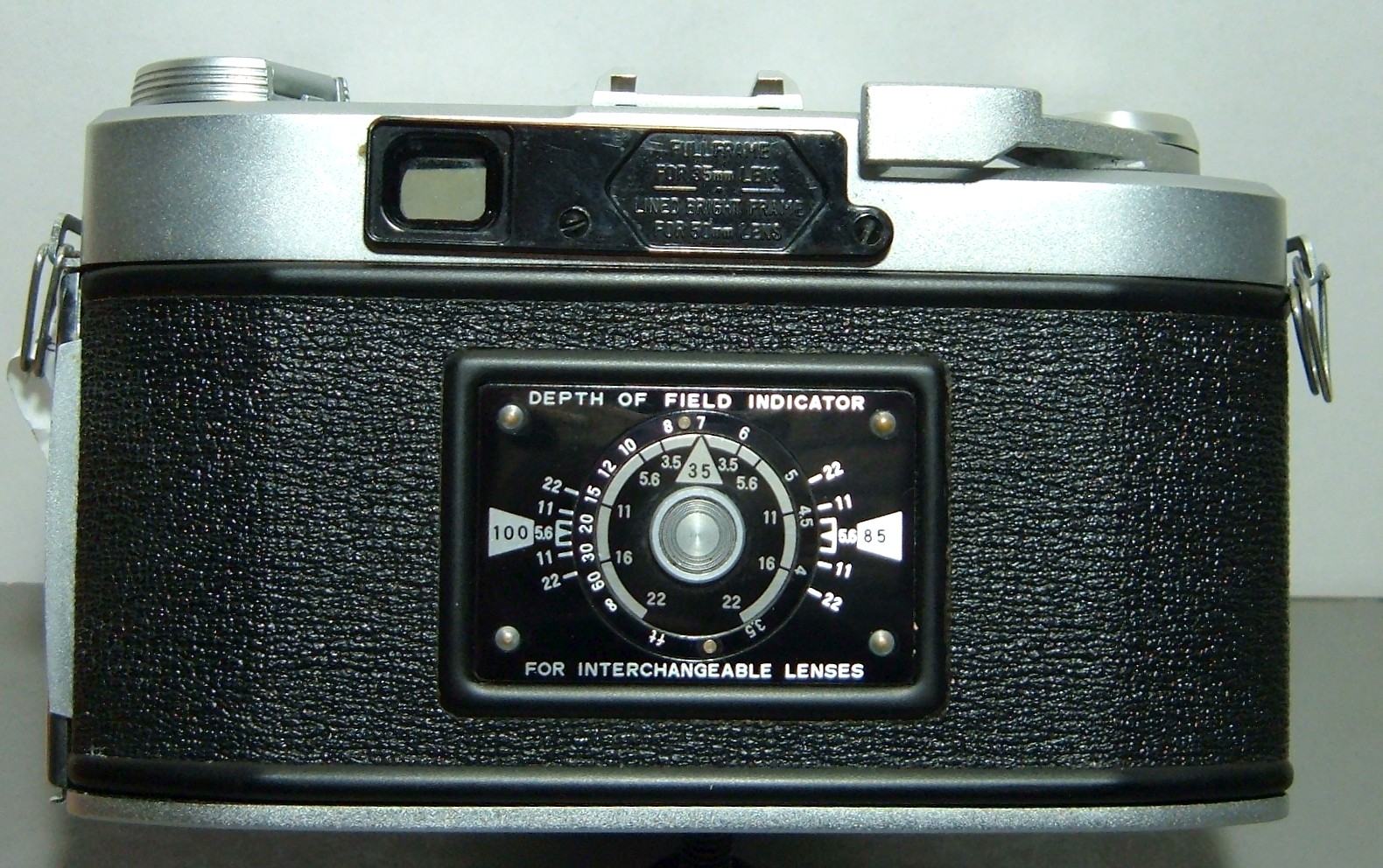
    The hinged back cover shown at the right features a Depth of Field Indicator for the camera's 100, 85, or 35mm interchangeable lenses. This is a welcome (if cumbersome) addition to the camera because the supplementary lenses do not have depth of field markings.  Another plus is the integrated rangefinder/viewfinder window, which was lacking in many other cameras of the fifties.
  Viewed from the top (photo left) the film rewind knob is on the left; the shutter speed selector and accessory shoe are at the center; and the film advance lever with ASA reminder, film counter, and shutter release are at the right.
      The lens barrel mounts a  2/50mm Super Rokkor lens and a  leaf type shutter. The blue dot marks the click-stopped diaphragm adjusting ring (f2-f22). Yellow denotes the lens removal ring, and red shows the mark you use to line up the lens with the camera's body for removal or replacement. Green indicates the focusing knob. Note that the Minolta A will accept only lenses that match its unique mount.

     Although I'd like to try this camera's three other lenses, the only one I possess is the 2/50 lens, which I found to have adequate sharpness and contrast. So that's a plus.
     Another plus is that, if you need to clean and lubricate the helical mount, it's easily accessible. Just remove the lens and you can get to the mount without a problem. That's important when you consider that many vintage cameras suffer from lubricant that has hardened and made it difficult (or in some cases) impossible to focus the camera.


COMING SOON: Mamiya 35 S2